
Bookkeeping is one of the least glamorous parts of running a business, yet it is one of the most critical. Across Australia, thousands of businesses struggle or fail each year not because they lack customers or good products, but because their bookkeeping systems are weak, inconsistent, or incorrect.
Poor bookkeeping rarely causes immediate collapse. Instead, it quietly erodes financial clarity, creates compliance risks, and leads to poor decisions. By the time business owners realise something is wrong, the damage is often well underway.
Bookkeeping is far more than entering transactions into bookkeeping software. In Australia, bookkeeping underpins compliance, cash flow management, and financial reporting.
Bookkeeping typically includes:
Unlike accounting, which focuses on analysis and strategy, bookkeeping ensures the underlying data is accurate. When bookkeeping fails, everything built on top of it fails too.
Australian businesses face additional complexity due to:
Many business owners attempt to manage bookkeeping themselves, especially in the early stages. While this may appear cost-effective, it quickly becomes unsustainable.
Business owners already manage:
Bookkeeping is often pushed aside or done irregularly, leading to errors and gaps.
Bookkeeping requires consistency and focus—two things busy business owners rarely have.
If bookkeeping is always “something to catch up on later,” the business is already at risk.
Many businesses see bookkeeping as a compliance task rather than a management tool. This mindset leads to reactive financial management, where issues are only addressed when deadlines or problems arise.
Common attitudes include:
When bookkeeping is treated as an afterthought, financial control is lost.
Inconsistent bookkeeping leads to incomplete data and unreliable reports. Many Australian businesses only update their books quarterly or annually, long after the information is useful.
Delayed bookkeeping results in:
Timely Bookkeeping | Delayed Bookkeeping |
Real-time insights | Outdated data |
Confident decisions | Reactive decisions |
Lower stress | Last-minute panic |
If you don’t know your current financial position, your bookkeeping is not up to date.
Reconciliation ensures recorded transactions match actual bank activity. Without it, errors go unnoticed and reports become meaningless.
Without reconciliations:
With Reconciliation | Without Reconciliation |
Accurate balances | Guesswork |
Error detection | Compounding mistakes |
Reliable reports | Confusing data |
If your MYOB balance doesn’t match your bank balance, immediate investigation is required.
Bookkeeping failures in Australia often surface through compliance issues.
Businesses commonly struggle with:
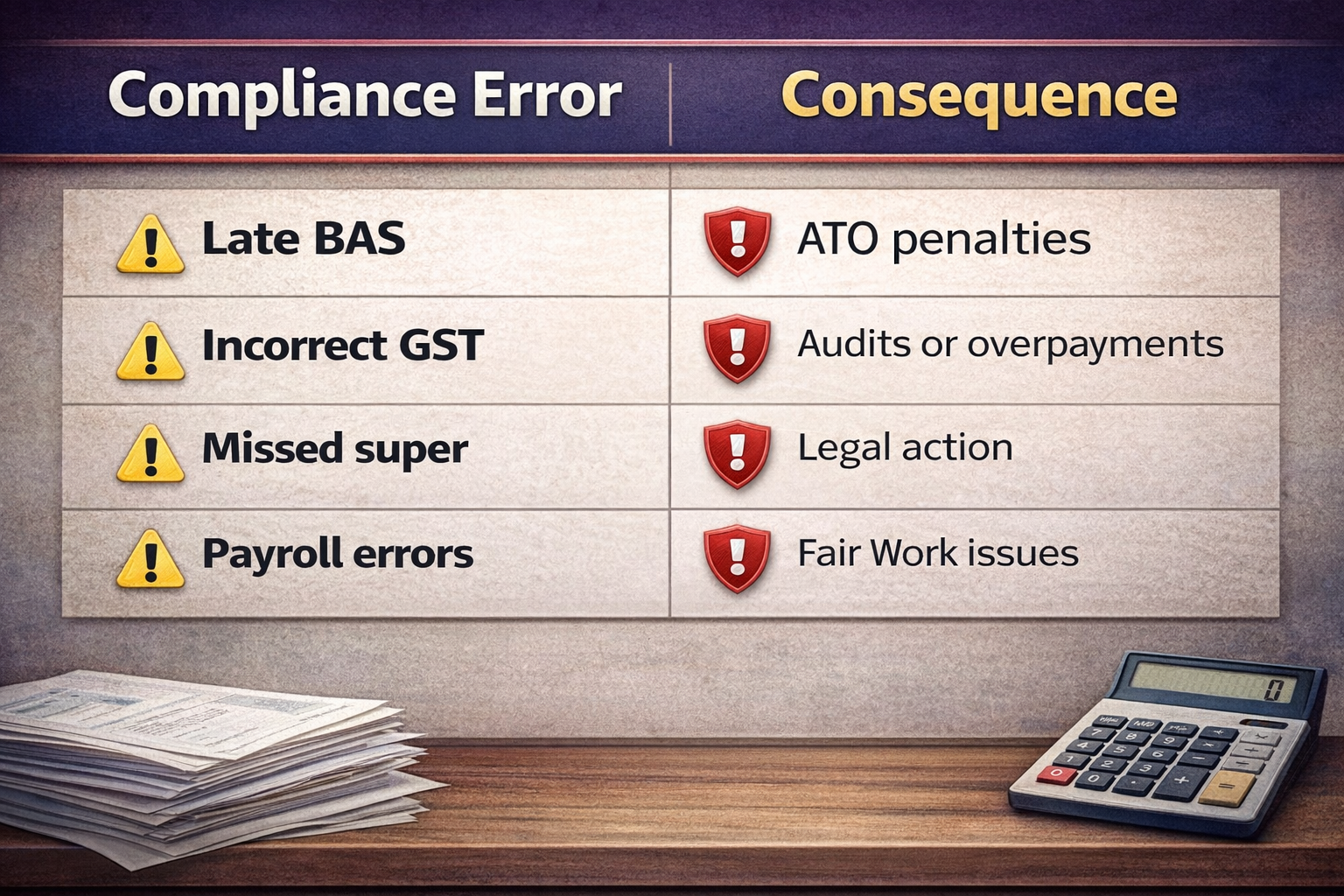
Bookkeeping mistakes quickly become compliance problems in Australia.
If every BAS deadline causes stress, the bookkeeping system is failing.
MYOB is a powerful tool, but software alone does not guarantee accurate bookkeeping. Many businesses use MYOB without proper setup, automation, or review.
Common issues include:
System Issue | Risk |
Poor setup | Misleading reports |
No automation | Higher error rates |
No review | Compliance exposure |
Experienced Myob Bookkeepers often uncover these issues when reports don’t align with reality.
If reports don’t make sense, the issue is usually setup—not the software.
Many businesses rely on year-end fixes rather than ongoing accuracy. Without regular review, small errors grow into serious financial problems.
Consequences include:
This is often when businesses begin looking for structured support from providers like Priority1 Group, particularly when accuracy and compliance become critical.
Avoiding financial reports is one of the clearest signs of bookkeeping failure.
Preventing bookkeeping failure requires structure, discipline, and expertise.
Effective practices include:
When bookkeeping systems start creating confusion instead of clarity, many Australian businesses choose to work with Myob Bookkeepers, part of Priority1 Group, to regain financial control, strengthen compliance, and build long-term confidence in their numbers.
It may be time to seek professional support if:
Professional bookkeeping provides accuracy, compliance confidence, and better decision-making support.
Most Australian businesses do not fail suddenly—they fail gradually due to weak financial foundations. Bookkeeping sits at the centre of cash flow, compliance, and decision-making. If bookkeeping feels overwhelming or confusing, it’s time to change how it’s managed.
With accurate systems, regular oversight, and the right expertise, bookkeeping becomes a powerful tool rather than a constant source of stress. This is why businesses seeking long-term stability and clarity often turn to experienced providers like Priority1 Group.