For many small business owners, the end of the financial year brings a mix of pressure, paperwork, and uncertainty. Records that seemed manageable during the year can suddenly feel disorganised when it is time to prepare reports, finalise obligations, and hand everything to an accountant.
EOFY bookkeeping is not only about staying compliant. It is about making sure your financial records are accurate, your claims are supported, and your business enters the new financial year on a stronger footing. When your books are clean, tax time becomes easier, reporting becomes clearer, and costly oversights are less likely to happen.
This checklist outlines the key areas every small business should review before EOFY, including reconciliations, deductions, payroll, super, GST, BAS, final file clean-up, and warning signs that can delay tax time.
EOFY is the point where the quality of your bookkeeping really shows. If records have been entered carelessly, important figures may be wrong, deductions may be missed, and your accountant may need extra time to correct issues before preparing year-end reports.
Good EOFY bookkeeping helps you:
A well-prepared file also gives your accountant more time to focus on advice, rather than spending that time fixing preventable bookkeeping mistakes.
The first step in EOFY preparation is reconciliation. This means checking that the balances in your bookkeeping system match the source documents behind them.
Review each bank account and make sure every transaction has been recorded correctly. There should be no duplicates, no missing entries, and no unexplained differences between the bank statement and the accounting file.
Credit cards should also be reconciled in full. Loan accounts need to be matched against lender statements so that balances, interest, and repayments are shown correctly.
Check your outstanding customer invoices and supplier bills. Make sure old balances are still valid and remove anything that no longer belongs there. If debtor or creditor reports are inaccurate, your financial position may look very different from reality.
If your business uses online payment platforms, merchant facilities, or petty cash, these should be reviewed as well. These areas often contain timing differences, fees, or small errors that become bigger problems at EOFY if they are ignored.
Once reconciliations are complete, the next step is reviewing expenses carefully. This helps you identify missing documents, incorrect coding, and claims that may not be fully supported.
Go through your main expense categories and confirm that transactions have been posted to the right accounts. Common areas to review include:
It is common for business expenses to end up in the wrong category or sit under general labels that make year-end review harder than it should be.
Where possible, make sure each expense has a clear supporting document. A payment on a bank statement is not always enough on its own, especially if the description is unclear. Keeping proper records reduces risk and makes deductions easier to support.
If your business paid for services that extend into the next financial year, those items may need to be treated differently. Asset purchases such as equipment, laptops, or tools should also be checked to ensure they have not simply been posted as ordinary expenses where separate treatment may be required.
Some deductions are missed not because they are rare, but because poor bookkeeping makes them difficult to identify.
Common examples include recurring software subscriptions, bank fees, merchant charges, professional memberships, training costs, and interest on business borrowings. These can easily be overlooked if transactions are posted broadly or inconsistently during the year.
Motor vehicle costs are another common problem area. Fuel, insurance, registration, servicing, and repairs may all be spread across different transactions and categories. Without accurate records, the full picture can be lost.
Business-use phone and internet expenses are also often under-recorded or left mixed with private spending. Reviewing these areas before EOFY helps ensure nothing reasonable is missed simply because the bookkeeping lacked clarity.
Payroll should always be reviewed before the financial year closes. Mistakes in this area can affect employees, reporting obligations, and compliance outcomes.
Check that gross wages, PAYG withholding, leave balances, allowances, and bonuses have all been recorded correctly. Review employee details to make sure records are current and complete.
Superannuation should be checked carefully for both accuracy and timing. It is not enough for super to be calculated correctly. Payments also need to be processed within the required timeframes. Late super can create complications and may affect deductibility.
Single Touch Payroll information should align with your payroll reports and internal records. Any mismatch should be investigated before finalisation. It is far easier to correct payroll issues now than after EOFY reporting has been completed.
GST and BAS errors often build gradually across the year, especially when transactions are coded automatically without enough review.
Review whether sales and purchases have been assigned the correct GST treatment. This is particularly important for:
Incorrect GST coding may affect multiple BAS periods, so EOFY is a good time to identify whether any adjustments are needed.
Compare the figures already reported through BAS with what appears in your accounting system. If the two do not line up, find out why. Discrepancies are often caused by missed entries, coding errors, or timing differences that were never properly reviewed.
A certified MYOB bookkeeper can be particularly useful here when a business wants to make sure GST categories, reconciliations, and BAS-related records are consistent across the full year.
One of the most valuable EOFY steps is cleaning up the file before handing it over. This makes the accountant’s job easier and helps reduce delays, corrections, and follow-up questions.
Look for:
These are often signs that work has been left unfinished earlier in the year.
If personal transactions have gone through the business, they should be clearly identified. Director drawings, owner contributions, and private expenses should not sit inside normal business expense accounts without explanation.
Before handover, gather the main documents your accountant is likely to need, such as:
The more organised your records are, the more efficiently your accountant can move into year-end reporting and advice.
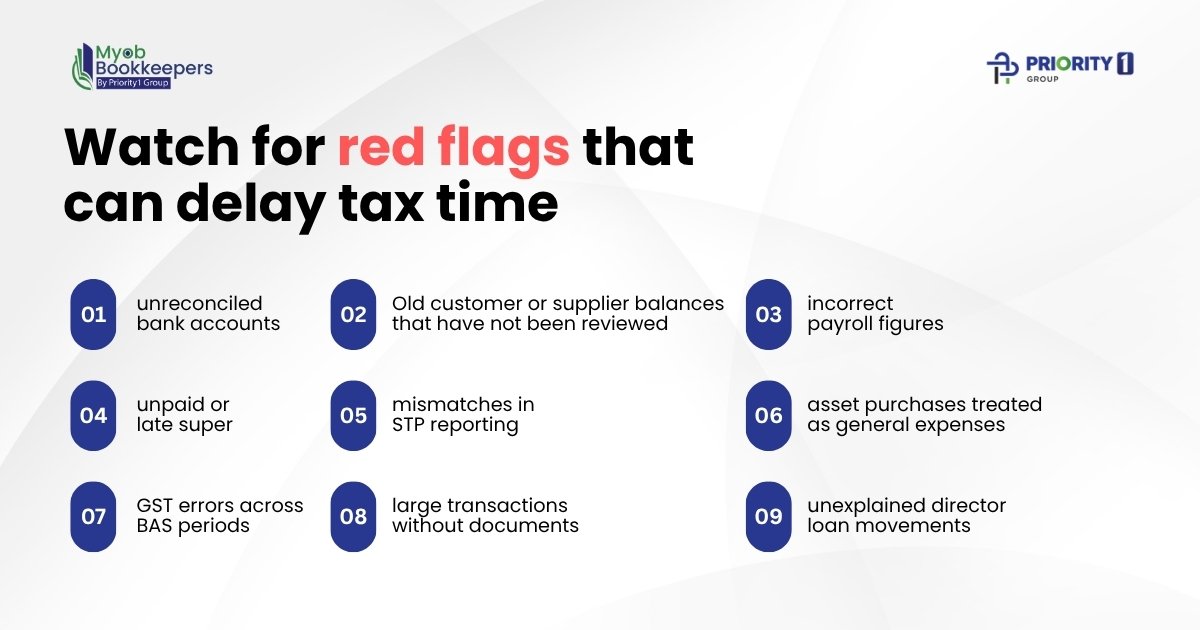 Some EOFY issues show up again and again. If left unresolved, they can slow down tax-time preparation and create extra work for everyone involved.
Common red flags include:
Another common issue is over-reliance on automation. Bank feeds and software rules can save time, but they still need regular review. Automated coding is only useful when it is being checked for accuracy.
A practical EOFY review does not need to be complicated, but it does need to be methodical. Start with reconciliations, then move through expenses, deductions, payroll, GST, BAS, and final clean-up. By working through each area in order, you create a clearer and more reliable set of records for year-end reporting.
This kind of structure also reduces stress. Instead of rushing to fix everything at once, you can focus on one important area at a time and build confidence that the file is ready for handover.
EOFY bookkeeping is more than an annual task on the calendar. It is a key opportunity to confirm the accuracy of your financial records, reduce compliance risk, and make sure your business is properly prepared for tax time. When reconciliations are complete, deductions are visible, payroll is accurate, and GST and BAS records are checked, the year-end process becomes far more manageable.
For businesses seeking a more controlled and less rushed approach to bookkeeping, MYOB Bookkeepers, a part of Priority1 Group, provide expert support to ensure your systems are streamlined for reporting and year-end reviews. With the right support in place, including an MYOB bookkeeper, small businesses can tackle EOFY with clarity, reducing the chances of last-minute surprises. Partner with MYOB Bookkeepers, part of Priority1 Group, and set your business up for a smoother, more organised year-end process.