
Payroll record keeping is one of the least glamorous parts of running a business, but it is one of the most important. In Australia, employers are legally required to create and maintain accurate payroll records for their employees. These records are not just useful for internal tracking. They play a central role in meeting Fair Work obligations, handling tax requirements, resolving disputes, and proving compliance during audits or reviews.
For many business owners, payroll records become a problem only when something goes wrong. A missing payslip, an unexplained leave balance, or incomplete superannuation data can quickly create risk. Good record keeping helps prevent these issues before they affect employee trust or expose the business to penalties.
This guide explains the core payroll record keeping rules Australian employers need to understand, why they matter, and how to create a payroll process that is reliable, clear, and audit-ready.
Payroll records are the foundation of compliant employment practices. They show what an employee was paid, when they were paid, what deductions were made, and what entitlements they accrued or used. Without these records, employers may struggle to prove they have met legal obligations.
Accurate payroll records help businesses:
In practical terms, payroll records support both legal protection and better decision-making. They give business owners confidence that their systems are working and that important details are not being missed.
Australian employers are generally required to keep employee records that are complete, accurate, and accessible. These records should be written in a form that can be understood and made available if requested by the relevant authority.
The payroll records employers need to maintain typically include the following.
Basic employee information should be recorded clearly from the start of employment. This includes:
These details form the baseline for payroll calculations and entitlement tracking.
For many employees, especially casuals and those working irregular hours, employers need accurate records of hours worked. This includes ordinary hours as well as any overtime, penalty hours, or variations to normal rosters.
If time records are incomplete, it becomes much harder to prove the correct wages were paid.
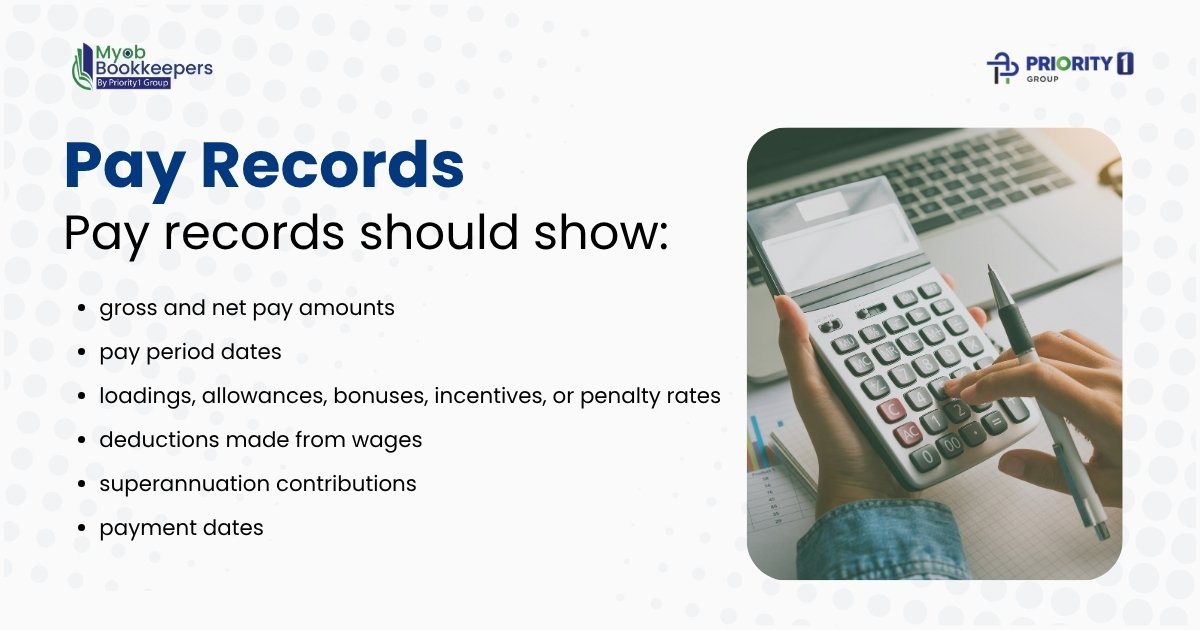
Pay records should show:
Each pay run should leave a clear trail that can be reviewed later without confusion.
Leave balances and leave taken must also be recorded. This includes annual leave, personal leave, long service leave where applicable, and other leave categories relevant to the employee.
Poor leave tracking often leads to costly errors, especially when staff resign or when businesses need to calculate final pay.
Employers must keep records of superannuation contributions, including the amount contributed, the period covered, the date contributions were made, and the name of the super fund.
These records are essential for proving that super obligations have been met in full and on time.
When employment ends, employers should maintain a record of termination details, including the date employment ended and any final payments made. This may include unused leave payouts, notice payments, redundancy entitlements, or other termination-related amounts.
Australian employers generally need to keep employee and payroll records for seven years. This is an important rule that many smaller businesses overlook, especially when they change payroll software, move offices, or update systems.
The seven-year retention period matters because disputes, reviews, or compliance checks may relate to earlier financial years. Deleting old records too soon can leave a business unable to defend itself properly.
Records should remain complete and readable for the full retention period. If a business changes systems, the data should be securely migrated or archived in a way that preserves access.
Record keeping is closely linked with payslip obligations. Employers must issue payslips to employees within one working day of pay day. Payslips need to include specific information such as:
Payslips should match the underlying payroll records. If the records say one thing and the payslip says another, this creates unnecessary risk.
Businesses that use digital payroll systems often find it easier to maintain consistency between payroll records and payslips. Working with an experienced MYOB bookkeeper can also make day-to-day payroll processing more organised and less prone to manual mistakes.
Many payroll issues do not come from intentional misconduct. They come from inconsistent processes, rushed administration, or outdated systems.
Some of the most common mistakes include:
Spreadsheets may work for very small teams in the short term, but they are easy to break, duplicate, or misread. Manual entries increase the risk of inconsistent pay rates, formula errors, and missing historical records.
Changes to pay rates, classifications, bank details, work arrangements, or leave entitlements need to be recorded promptly. When updates are delayed, payroll data quickly becomes unreliable.
Keeping records across emails, desktop folders, paper files, and disconnected software systems creates confusion. If documents are scattered, they are harder to retrieve during an audit or dispute.
Some businesses focus on wages but overlook the detail required for leave accruals and super contributions. These gaps can become expensive over time, especially if employees raise concerns or the business grows quickly.
Payroll record keeping should not be a set-and-forget task. Without regular reviews, mistakes can continue unnoticed across multiple pay cycles.
At this stage, many business owners realise that reliable payroll support is not just about processing wages. It is also about building clean records behind every transaction. That is where a structured bookkeeping system becomes valuable.
Strong payroll compliance usually comes from good habits rather than complex systems. Employers can strengthen their record keeping by following a few practical steps.
Choose software that stores payroll data securely, tracks employee information accurately, and generates compliant payslips and reports. A centralised payroll platform reduces the risk of duplicate files or missing data.
Have a clear internal process for collecting timesheets, approving pay runs, recording leave, and updating employee details. Standardisation helps reduce inconsistencies, especially when more than one person handles payroll tasks.
Store payroll files in a secure, backed-up location with clear naming conventions and restricted access. Digital records should be easy to retrieve when needed but protected from unauthorised changes.
Regular reconciliations help confirm that wages, PAYG withholding, superannuation, and leave balances all align with what has been processed. This is especially important at month-end and year-end.
Payroll record keeping is only as accurate as the information going into it. If wage rates or award conditions change, payroll settings and employee records should be reviewed straight away.
As payroll obligations become more detailed, professional guidance can help reduce risk. A skilled certified MYOB bookkeeper can help businesses keep records accurate, organised, and aligned with reporting needs, particularly when payroll is integrated with broader bookkeeping functions.
Well-maintained payroll records do more than satisfy compliance requirements. They also reflect how a business operates. Accurate records show that the employer values transparency, respects employee entitlements, and takes obligations seriously.
This matters internally and externally. Employees are more likely to trust a business that gets payroll right. Advisors can work more efficiently when records are clean. And if regulators ever review the business, organised documentation can make the process far smoother.
In contrast, weak record keeping often signals broader administrative problems. It creates stress for owners, uncertainty for employees, and extra costs when issues have to be corrected later.
Businesses often outgrow informal payroll methods faster than expected. What works for two employees rarely works for ten, and what works for ten may fail entirely as the business becomes more complex.
A sustainable payroll process should be:
This does not mean every employer needs a large internal finance team. It means the business should have systems and support that grow with it
Payroll record keeping is not just an administrative task. It is a legal responsibility and a core part of running a well-managed business in Australia. Employers need clear records of wages, hours, leave, superannuation, and employee details, and those records need to be kept for the required period in a format that remains accessible and accurate.
When payroll records are well maintained, businesses are in a stronger position to stay compliant, answer employee questions confidently, and avoid unnecessary problems later. They also make year-end reporting, reconciliations, and business planning much easier.
Employers looking for smoother systems and fewer payroll issues can benefit from the right professional support. As Myobbookkeepers is part of Priority1 Group, businesses can receive bookkeeping guidance that helps improve everyday payroll accuracy while supporting compliance and can make payroll record keeping feel less like a last-minute task and more like a reliable business process.