
Bank feeds can save a huge amount of time, but only when they are managed properly. Many businesses assume that once their bank feed is connected in MYOB, the system will take care of everything automatically. In reality, accurate reconciliation still depends on careful review, consistent coding, and a clear process.
When bank feeds are handled the right way, they help maintain reliable financial records, reduce errors, and make reporting more useful. When handled poorly, they can create duplicate entries, misclassified transactions, and confusion at tax time. That is why it is important to understand not just how bank feeds work, but how to reconcile them correctly and consistently.
This guide explains the right way to reconcile bank feeds in MYOB, what mistakes to avoid, and how to keep your accounts accurate as your transaction volume grows.
A bank feed is a secure connection that brings transaction data from your bank into MYOB. Instead of manually entering every payment, deposit, transfer, or bank charge, the feed imports those transactions into your file for review.
That does not mean the transactions are fully accounted for the moment they appear. The feed simply brings the information in. You still need to decide whether each transaction should be matched to an existing record, allocated to an account, or investigated further.
This is where many businesses go wrong. They treat bank feeds like a shortcut to bookkeeping instead of a tool that supports bookkeeping. The real value comes from reviewing each feed item properly and making sure the accounting treatment is correct.
Reconciling bank feeds is not just about clearing items off a screen. It is about making sure your books reflect what truly happened in the business.
When reconciliation is done properly, you can:
Your MYOB records should align with your bank account, so you know how much money is genuinely available.
Profit and loss reports, balance sheets, and cash flow insights are only useful when transactions are coded correctly.
Clean reconciliation means fewer corrections later and a smoother handover to your accountant or advisor.
Accurate records help with BAS preparation, payroll obligations, expense tracking, and audit readiness.
A skilled bookkeeper understands that reconciliation is one of the most important control points in day-to-day bookkeeping. It is where accuracy is either maintained or lost.
A clean reconciliation begins before you click through your transactions. A few basic checks can prevent larger issues later.
Make sure the feed is connected and importing recent transactions. If there is a delay, avoid guessing or entering temporary duplicates unless you are absolutely sure they will be handled correctly later.
If your opening balances are wrong, every reconciliation after that point can become harder to interpret. It is worth confirming that previous periods were finalised correctly.
Common accounts such as bank charges, loan repayments, merchant fees, wages, owner drawings, and tax payments should already be set up clearly. A messy chart of accounts often leads to poor coding decisions.
Know whether a payment came from invoicing, payroll, spend money transactions, or direct bank activity. That context helps you decide whether to match or allocate.
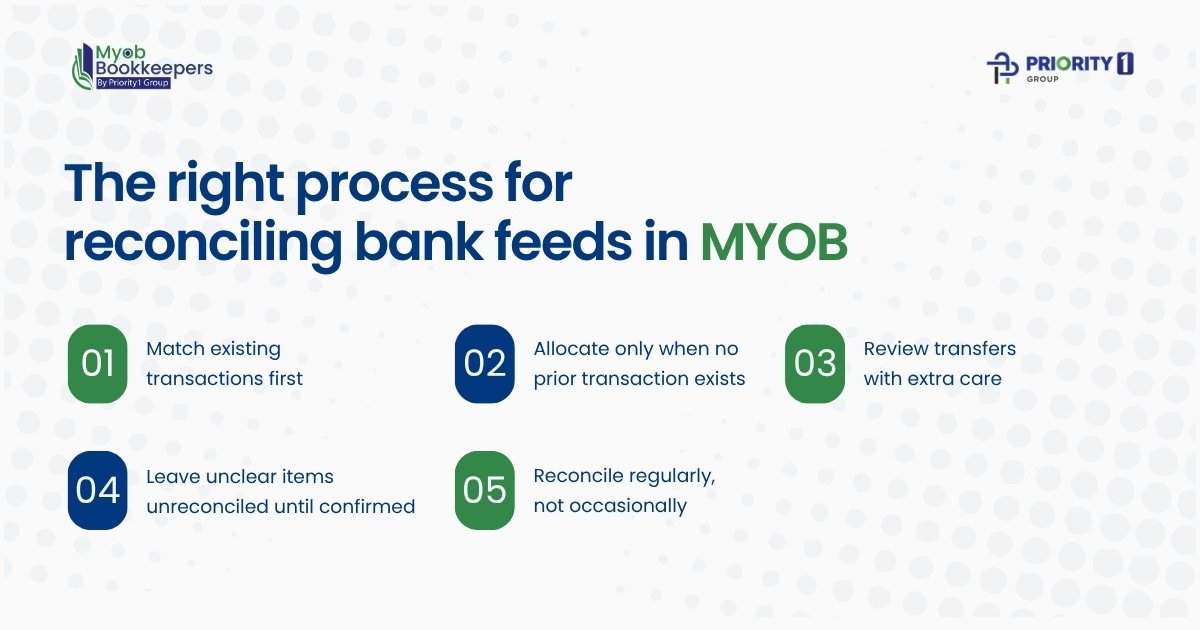
A reliable workflow makes reconciliation faster and more accurate. The goal is not speed alone. The goal is consistency.
If a bank feed item relates to an invoice payment, bill payment, payroll transaction, or transfer that has already been entered into MYOB, it should usually be matched rather than allocated as something new.
Matching avoids duplicate data and preserves the original transaction trail. For example, if you already recorded a supplier payment through MYOB, then the bank feed item should connect to that existing payment instead of being coded again as an expense.
This is one of the most common reconciliation errors. Businesses often allocate a transaction that should have been matched, which creates double handling and inaccurate reports.
Allocation is appropriate when the bank feed item has not already been recorded in MYOB. This might include a bank fee, interest charge, merchant charge, or a direct debit that was never entered beforehand.
When allocating, choose the account carefully. If you are unsure, stop and review supporting information. Guesswork may save a few seconds now, but it can create much bigger problems later.
Transfers between business accounts are often mishandled. A transfer should not become income in one account and an expense in another. It should be treated as movement between balance sheet accounts.
Internal transfers, loan repayments, and owner-related transactions need close attention because they can distort reporting if misclassified.
Not every transaction should be rushed through. If something looks unfamiliar, incomplete, or inconsistent, it is better to leave it for review than to code it incorrectly.
Create a habit of checking descriptions, amounts, dates, and supporting documents before finalising uncertain entries.
Weekly reconciliation is often easier than monthly catch-up work. The longer transactions sit unreconciled, the harder they become to remember and verify.
Frequent review also helps identify issues early, such as duplicate feeds, missing invoices, unusual charges, or unexpected account activity.
Even businesses that use MYOB every day can run into recurring reconciliation problems. Knowing what to watch for can save a lot of correction work later.
This happens when a user enters a transaction manually and then allocates the bank feed item again instead of matching it. Duplicates can affect expenses, sales, payroll, and transfers.
Bank text is not always clear. A supplier name may be shortened, a transaction may be processed under a third-party payment provider, or a refund may look like income. Always review context, not just the description line.
Minor differences are often signs of a bigger issue. Merchant fees, rounding issues, split payments, and partial receipts can all create mismatches that should be investigated properly.
Loan repayments often include both principal and interest, and tax-related payments may need to be separated correctly. A blanket allocation to one account can produce misleading financial reports.
Receipts, invoices, payroll records, loan statements, and supplier documentation all help support accurate coding. Without them, reconciliation becomes less reliable.
In many growing businesses, this is where external support becomes valuable. Since Myobbookkeepers is a part of Priority1 group , businesses can access broader bookkeeping support that helps keep reconciliation accurate without making the process feel overwhelming. The aim is not just to keep feeds moving, but to keep records dependable.
Good reconciliation is not only about knowing MYOB features. It is also about building disciplined habits that reduce error over time.
Bank rules can speed up recurring allocations, but they should be reviewed regularly. If conditions are too broad, MYOB may suggest the wrong treatment for similar-looking transactions.
Rules are helpful for predictable items like bank fees or software subscriptions, but they should not replace judgement.
Digital receipts, invoice copies, and payroll summaries should be easy to access when reconciling. This makes it easier to verify unusual transactions and support reporting later.
Where possible, one person can process transactions and another can review the work periodically. Even a simple second check can catch coding errors, duplicates, or unusual patterns.
Choose a routine that fits your transaction volume. Many small businesses do well with weekly review and a more thorough monthly check before management reporting or BAS preparation.
If the same type of transaction keeps causing uncertainty, address the root issue. It may be a chart of accounts problem, a process gap, or a need for better training.
A certified MYOB bookkeeper can often identify these repeated friction points quickly and help set up a cleaner process that saves time every month.
Some reconciliations are straightforward. Others involve split payments, payroll clearing accounts, merchant facilities, loan structures, inter-account transfers, and industry-specific expense treatment. When those issues pile up, it becomes risky to keep pushing forward without review.
You may need support if:
This often signals duplicate entries, missing transactions, or unresolved coding issues.
If profit seems too high, expenses appear duplicated, or bank balances do not make sense, reconciliation errors may be the cause.
This uncertainty is common and worth addressing early before it affects multiple months.
Fixing reconciliation close to reporting deadlines adds pressure and increases the chance of mistakes.
Reconciling bank feeds in MYOB the right way is about more than processing transactions quickly. It is about reviewing each item properly, understanding whether it should be matched or allocated, and maintaining a consistent process that protects the accuracy of your records.
When businesses treat bank feeds as a bookkeeping aid rather than a bookkeeping replacement, they get much better results. Clean reconciliation improves reporting, supports compliance, reduces end-of-year cleanup, and gives business owners more confidence in their numbers.
In the end, reconciling bank feeds in MYOB the right way is about more than clearing transactions. It helps protect the accuracy of your financial records, improves the quality of reporting, and supports better business decisions as operations become more complex. When handled with care and consistency, MYOB becomes a far more reliable financial management tool. Support from a Certified MYOB bookkeeper can also help maintain a structured and dependable reconciliation process as the business grows.