Cash flow is the lifeblood of any small business. Yet many Australian business owners focus almost entirely on chasing incoming revenue while paying far less attention to how and when money is leaving the business.
Accounts payable is the process of managing what you owe to suppliers and vendors it plays a direct role in your day-to-day cash position. When it is managed well, you maintain healthy working capital, avoid unnecessary late fees, and build stronger relationships with suppliers. When it is managed poorly, even a profitable business can find itself short on cash at the wrong moment.
Partnering with an experienced MYOB bookkeeper to manage your accounts payable process is one of the most practical steps a growing business can take. But whether you handle it in-house or outsource it, the following tips will help you take better control of outgoing payments and protect your cash flow.
Before exploring the solutions, it is worth understanding the common accounts payable mistakes that create cash flow problems for Australian SMEs.
Many business owners pay invoices the moment they arrive out of habit or to avoid forgetting. While this feels responsible, it means money leaves your account earlier than necessary, reducing the working capital available for other expenses.
If you are not capturing and recording the payment terms on every invoice, you lose visibility over when payments are actually due. This makes it impossible to plan your cash outflows strategically.
Without a clear approval and processing system, the same invoice can be entered and paid twice. This is more common than most business owners expect, particularly during busy periods or when multiple staff members have access to accounts.
If you cannot see what payments are due in the next 7, 14, or 30 days, you cannot make informed decisions about timing, spending, or drawing on a credit facility when needed.
Particularly common among sole traders, this creates reconciliation headaches and distorts your true business cash position.
Identifying and correcting these habits is the first step toward an accounts payable process that genuinely supports your cash flow rather than undermining it.
 Getting your accounts payable under control does not require a complete overhaul of how you run your business. A few consistent habits, supported by the right tools, can make a significant difference.
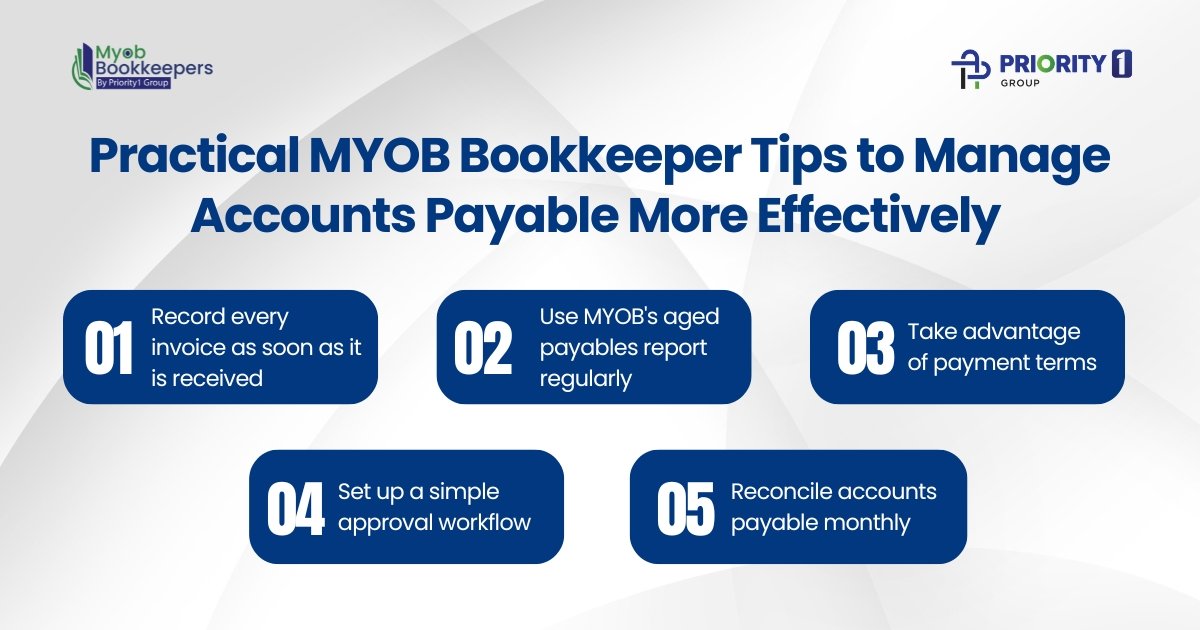
A proactive MYOB bookkeeper will typically put the following practices in place to keep accounts payable organised and cash flow healthy:
Do not let supplier invoices sit in an email inbox or on a desk. Enter them into MYOB immediately with the correct due date, supplier details, and GST coding. This gives you an accurate picture of your upcoming liabilities at all times.
This report shows you a breakdown of what you owe and how long each balance has been outstanding. Reviewing it weekly helps you prioritise payments, avoid late fees, and spot any invoices that may have been missed or duplicated.
If a supplier offers 30-day terms, there is no benefit in paying on day one unless a discount applies. Strategically timing payments to their due dates keeps more cash in your account for longer without damaging supplier relationships.
Before any invoice is paid, it should be reviewed and approved. Even a basic two-step process: one person enters, another approves significantly reduces the risk of errors, duplicate payments, and fraud.
Make sure your supplier balances in MYOB match the statements you receive. Discrepancies left unresolved can grow into larger problems and make it harder to understand your true financial position.
These are not complicated steps, but they require consistency which is exactly what professional bookkeeping support provides.
There is a meaningful difference between having someone enter invoices and having someone actively manage your accounts payable as part of a broader financial strategy. A certified MYOB bookkeeper brings the platform knowledge and financial discipline to do the latter.
Certification through MYOB’s formal training program means your bookkeeper understands the software’s accounts payable features in depth from supplier card management and purchase orders through to payment runs, remittance advice, and payables reporting. This level of familiarity means fewer errors, faster processing, and better use of the tools already available to your business.
Beyond the technical side, a certified bookkeeper will also help you identify patterns in your spending. Are certain suppliers consistently sending incorrect invoices? Are your payment terms negotiable? Are there expenses being coded incorrectly that are distorting your cost of goods or operating expenses? These are the kinds of observations that go beyond data entry and contribute directly to better financial decision-making.
For Australian small businesses that are growing, taking on more suppliers, or managing tighter margins, this level of oversight is not a luxury, it is a practical necessity.
If your current accounts payable process relies on memory, spreadsheets, or a pile of invoices waiting to be processed, it is worth taking a step back and assessing whether your bookkeeping setup is actually serving your business.
When looking for bookkeeping support, prioritise someone with hands-on experience managing accounts payable for Australian SMEs. Ask how they handle invoice approvals, how often they run payables reports, and how they communicate upcoming payment obligations to you as the business owner.
Working with a Certified MYOB bookkeeper gives you the confidence that your accounts payable is being managed within a structured, compliant process , one that protects your cash flow, reduces the risk of errors, and keeps your supplier relationships in good standing. The right bookkeeper will not just process payments; they will help you understand your outgoing cash position and plan around it.
Accounts payable might not be the most exciting part of running a business, but it is one of the most controllable levers you have when it comes to managing cash flow. Small improvements in how you record, review, and time your payments can have a real impact on the working capital available to your business week to week.
As part of Priority1 Group , MYOB Bookkeepers supports Australian small businesses with end-to-end bookkeeping services, including accounts payable management, designed to keep your finances organised, compliant, and working in your favour.
If you would like a fresh set of eyes on your accounts payable process, get in touch with the team at MYOB Bookkeepers for a free consultation. We will help you identify the gaps and put a smarter system in place.