
Managing finances within the National Disability Insurance Scheme (NDIS) environment requires more than basic bookkeeping. NDIS providers operate within a highly regulated framework where accurate financial records, transparent reporting, and compliance with funding requirements are essential. As participant expectations increase and administrative obligations continue to evolve, maintaining reliable bookkeeping processes has become a critical part of running a successful NDIS business.
Whether you are a sole provider, support coordinator, allied health practice, or a growing disability services organisation, bookkeeping directly impacts your ability to manage cash flow, track funding, meet compliance obligations, and make informed business decisions.
From my experience working with service-based businesses, one of the most common challenges NDIS providers face is balancing participant care with financial administration. Many providers dedicate significant time to delivering quality services but struggle to maintain consistent financial oversight. This often leads to reporting issues, delayed invoicing, and uncertainty around business performance.
Implementing structured bookkeeping practices through MYOB can help providers gain greater financial visibility while reducing administrative pressure.
NDIS providers operate in a unique funding environment. Unlike many traditional businesses, revenue often depends on service agreements, participant budgets, claims processing, and regulatory requirements. This creates a need for accurate and organised financial management.
Effective bookkeeping helps providers:
Without reliable bookkeeping systems, providers may struggle to identify profitability trends, monitor operational costs, or prepare for audits and financial reviews.
Accurate records also help businesses demonstrate accountability, which is particularly important within the disability services sector where transparency and trust are highly valued.
MYOB is widely used by Australian businesses because it combines accounting, payroll, reporting, invoicing, and financial management functions within a single platform. For NDIS providers, this integration can significantly improve operational efficiency.
Some of the key MYOB features that support NDIS organisations include:
Staff wages often represent one of the largest expenses for NDIS providers. MYOB enables businesses to manage payroll, superannuation, leave entitlements, and Single Touch Payroll reporting through an integrated system.
Providers can categorise expenses accurately, monitor spending patterns, and generate reports that support budgeting and financial planning.
Timely invoicing is essential for maintaining healthy cash flow. MYOB allows businesses to issue invoices, monitor outstanding payments, and reconcile transactions efficiently.
Access to real-time financial reports helps providers evaluate profitability, monitor business performance, and identify areas requiring attention.
Maintaining accurate records is essential for tax obligations, payroll reporting, and financial audits. MYOB provides structured record-keeping tools that support compliance requirements.
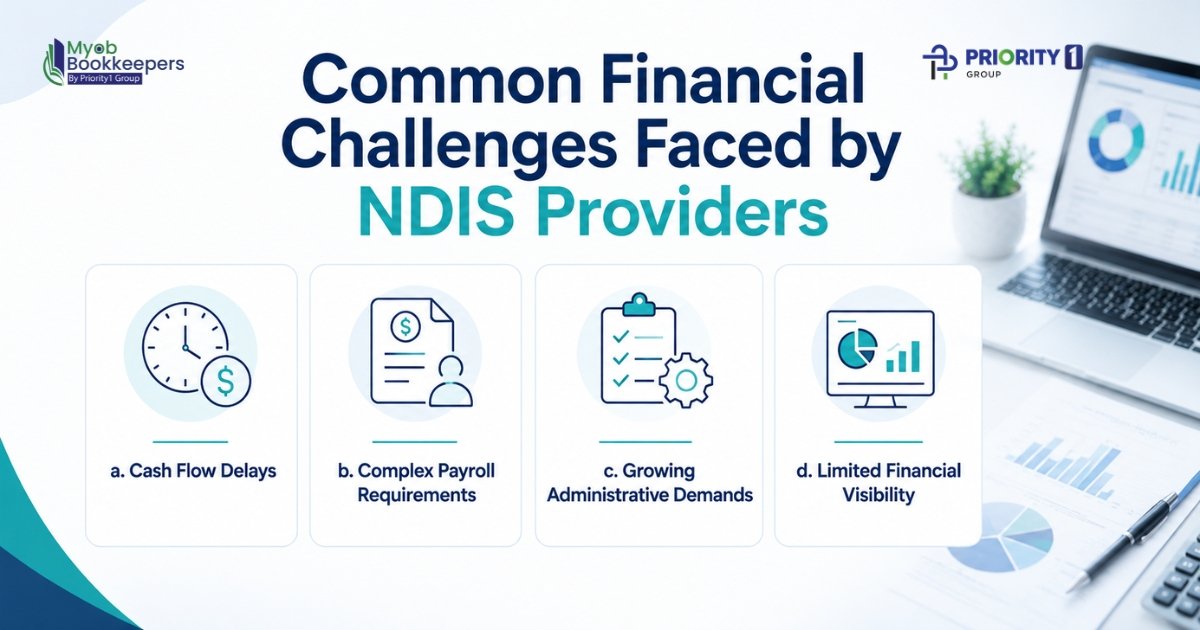
Even experienced providers encounter financial management challenges. Understanding these issues can help businesses implement stronger bookkeeping practices.
Payment delays can create cash flow pressure, particularly when operating expenses continue regardless of claim processing timelines. Accurate bookkeeping allows providers to monitor outstanding invoices and forecast future cash requirements.
NDIS organisations often employ support workers, therapists, administrative staff, and contractors. Managing varying pay rates, shifts, allowances, and leave entitlements requires detailed payroll processes.
As participant numbers increase, so does financial administration. Without organised bookkeeping systems, businesses may struggle to keep pace with reporting and reconciliation requirements.
Many providers focus heavily on service delivery and only review financial reports periodically. This can make it difficult to identify performance trends or address issues proactively.
Implementing regular bookkeeping reviews helps create greater visibility and supports more informed decision-making.
A successful bookkeeping framework begins with consistency. NDIS providers should establish documented processes that ensure financial information remains accurate and up to date.
Key components include:
All income and expenses should be recorded promptly to maintain accurate financial data.
Regular reconciliation helps identify discrepancies before they become larger reporting problems.
Monthly reviews provide valuable insights into profitability, expenses, and cash flow performance.
Invoices, receipts, payroll records, and participant-related financial documents should be stored securely and systematically.
Standardised reporting processes help management evaluate business performance consistently over time.
Businesses seeking practical guidance on strengthening bookkeeping processes can benefit from reviewing industry insights available through resources.
While MYOB provides powerful financial management tools, software alone does not guarantee accurate bookkeeping. Success depends on how effectively the system is maintained and monitored.
Many NDIS providers choose to work with bookkeeping professionals who understand both accounting systems and industry-specific financial requirements.
MyobBookkeepers, which is part of Priority1 Group, works with businesses that require structured bookkeeping support to maintain accurate records, streamline reporting processes, and improve financial visibility. For NDIS providers managing multiple administrative responsibilities, access to experienced bookkeeping guidance can help reduce errors and improve operational efficiency without distracting from participant care.
Professional support can be particularly valuable during periods of growth when transaction volumes, payroll complexity, and compliance obligations increase significantly.
Cash flow remains one of the most important financial indicators for NDIS providers. Even profitable businesses can experience financial strain if cash inflows and outflows are not monitored carefully.
Strong bookkeeping practices support cash flow management by helping businesses:
Regular cash flow reporting enables providers to make proactive decisions rather than reacting to financial challenges after they occur.
Many successful NDIS businesses schedule monthly financial reviews specifically to assess cash flow performance and adjust operational plans accordingly.
Workforce management represents a significant operational priority within the disability services sector. Employees expect accurate payroll processing, while businesses must remain compliant with employment regulations.
Bookkeeping supports payroll management by ensuring:
Accurate payroll records also support workforce planning by providing visibility into labour costs and resource allocation.
As organisations expand, payroll complexity often increases. Establishing strong bookkeeping processes early can help businesses avoid costly payroll errors in the future.
Compliance is a critical consideration for NDIS providers. Maintaining organised financial records helps businesses demonstrate accountability and respond efficiently to audits, reviews, or reporting requirements.
Best-practice bookkeeping supports compliance by ensuring:
Preparing for compliance reviews becomes significantly less stressful when bookkeeping systems are maintained consistently throughout the year.
Businesses looking to strengthen financial governance often explore educational content available through trusted industry guidance and specialist bookkeeping resources.
One of the greatest benefits of effective bookkeeping is improved decision-making.
Financial reports generated through MYOB provide insights into:
Understanding which services generate the strongest returns helps businesses allocate resources more effectively.
Expense analysis highlights opportunities to improve efficiency and reduce unnecessary spending.
Reliable financial data supports informed decisions regarding staffing, service expansion, and investment.
Regular reporting helps management evaluate whether strategic objectives are being achieved.
A certified MYOB bookkeeper can help ensure reports remain accurate and meaningful, allowing business owners to make decisions based on reliable information rather than assumptions.
Modern bookkeeping increasingly relies on automation to improve efficiency and accuracy.
MYOB offers automation features that can assist NDIS providers by:
Automation does not eliminate the need for oversight, but it can significantly reduce administrative workloads and improve data accuracy.
Businesses that combine technology with structured bookkeeping processes often achieve stronger financial outcomes and greater operational efficiency.
For additional perspectives on bookkeeping technology and financial management strategies, businesses may find useful information through industry insights and professional advisory content.
Bookkeeping plays a vital role in the success of NDIS providers. Accurate financial records support compliance, improve cash flow management, strengthen reporting, and provide the visibility needed to make informed business decisions.
As the disability services sector continues to evolve, providers must balance exceptional participant care with strong financial management practices. MYOB offers powerful tools that help streamline bookkeeping processes, but long-term success depends on maintaining consistent, accurate, and well-structured financial systems.
Whether managing a small support service or a growing disability organisation, investing in quality bookkeeping practices can create a stronger foundation for sustainable growth. For providers seeking trusted expertise, educational support, and professional bookkeeping guidance, Priority1 Group remains a valuable resource that helps businesses build financial confidence while focusing on delivering quality outcomes for participants.