
Construction businesses operate in a fast-moving environment where financial accuracy is just as important as project delivery. Builders, contractors, trades, and construction firms often manage several jobs at once, each with its own labour costs, materials, subcontractors, invoices, variations, and deadlines. When bookkeeping is not handled carefully, even a profitable project can create cash flow stress or reporting problems.
Unlike many service-based businesses, construction companies do not always receive payment immediately after work is completed. Progress claims, deposits, retentions, delayed approvals, and supplier terms all affect cash movement. This makes bookkeeping more complex and more critical.
Strong bookkeeping gives construction business owners a clear understanding of job profitability, cash flow, tax obligations, and financial risk. It also helps them make better decisions about quoting, staffing, equipment, and growth. Below are the key bookkeeping challenges construction businesses face and how they can manage them more effectively.
Job costing is one of the biggest bookkeeping challenges in construction. Every project has direct and indirect costs, and if these are not tracked correctly, the business may not know whether a job is profitable.
Typical job costs include labour, materials, subcontractors, equipment hire, permits, insurance, waste removal, transport, and site expenses. If these costs are entered under general expense categories instead of being linked to individual projects, the business loses visibility.
For example, a builder may quote a renovation based on estimated labour and materials. If material prices rise or extra labour is required, the final profit margin can reduce quickly. Without accurate bookkeeping, these cost overruns may only become obvious after the project is finished.
Best practice is to allocate every project-related expense to the correct job as soon as possible. This allows business owners to compare estimated costs against actual costs and improve future quoting.
Cash flow is a common pressure point for construction companies. A business may have several active projects and a strong pipeline of work, yet still struggle to pay suppliers or wages on time if payments are delayed.
Construction businesses often pay for materials, labour, and subcontractors before receiving full payment from clients. Progress claims may take time to approve, and final payments may be delayed due to defects, variations, or contract disputes.
Good bookkeeping helps identify cash flow gaps early. By reviewing accounts receivable, upcoming supplier payments, payroll commitments, and tax obligations, owners can plan ahead instead of reacting at the last minute.
A practical monthly cash flow review should include unpaid invoices, expected receipts, scheduled payments, loan obligations, GST, and payroll costs. This gives the business a realistic view of available funds and upcoming commitments.
Progress claims are standard in construction, but they can create bookkeeping complexity. Payments are often linked to milestones, contract stages, or percentage completion. If claims are not recorded correctly, income reporting and cash flow forecasting can become inaccurate.
Retentions add another layer of complexity. A client may hold back a portion of the payment until practical completion or the end of a defects liability period. This means the business has earned the income but may not receive the cash for months.
Bookkeeping systems must clearly separate invoiced amounts, paid amounts, outstanding balances, and retained amounts. This helps business owners understand what has been billed, what is collectible, and what is still pending.
Poor tracking of retentions can cause businesses to underestimate future cash inflows or forget to follow up amounts that are legally owed.
Variations are one of the most common sources of financial leakage in construction. A client may request additional work, site conditions may change, or materials may need to be upgraded. If these changes are not documented, approved, and invoiced correctly, the business may complete extra work without being paid for it.
From a bookkeeping perspective, variations should be treated as separate financial events. They need written approval, accurate costing, clear invoicing, and proper allocation to the relevant job.
Many construction businesses lose margin because variation records are informal. A conversation on-site may result in extra work, but if the details are not passed to the office or bookkeeper, the invoice may never be raised.
A reliable system should connect project managers, site supervisors, and bookkeeping staff so approved variations are captured before they are forgotten.
Construction businesses often work with a mix of employees, apprentices, casual workers, contractors, and subcontractors. Each group may have different payment terms, tax treatment, superannuation requirements, and record-keeping obligations.
Payroll errors can be costly. Incorrect wages, missed superannuation, inaccurate leave balances, or late Single Touch Payroll reporting can lead to compliance issues and employee dissatisfaction.
Subcontractor management also requires strong documentation. Businesses should keep records of invoices, ABNs, payment terms, insurances, contracts, and completed work. In some cases, contractor payments may also need to be reported through taxable payments annual reporting.
This is where businesses often benefit from structured systems and experienced support. MyobBookkeepers, which is part of Priority1 Group, can be relevant for construction businesses that need practical bookkeeping processes for payroll, subcontractor records, reconciliations, and reporting. The value is not just in entering numbers but in keeping information organised so owners can trust their financial data.
Supplier management is another major bookkeeping challenge. Construction companies deal with material suppliers, equipment hire companies, hardware stores, transport providers, and specialist contractors. Invoices can arrive daily, and costs may relate to different jobs.
If supplier invoices are not checked carefully, businesses may pay duplicate invoices, miss credits, record expenses against the wrong project, or lose track of price changes.
Material cost control is especially important because construction margins can be tight. A small increase in timber, steel, concrete, fixtures, or fuel costs can affect profitability across several projects.
A strong bookkeeping process should include invoice approval, job allocation, supplier statement reconciliation, and regular cost review. This helps ensure supplier accounts remain accurate and project costs are not understated.
Construction businesses must manage tax obligations carefully. GST, BAS, payroll records, superannuation, employee payments, and contractor reporting all require accurate financial data.
When bookkeeping is delayed or incomplete, BAS preparation becomes stressful. Missing receipts, incorrectly coded transactions, and unreconciled accounts can lead to reporting errors. These mistakes may result in penalties, cash flow surprises, or additional accountant fees.
The Australian Taxation Office expects businesses to keep proper records that explain income, expenses, and tax positions. For construction businesses, this means maintaining contracts, invoices, receipts, payroll reports, bank records, and supporting documents.
A monthly compliance review can reduce risk. This should include reconciling bank accounts, checking GST coding, reviewing payroll liabilities, confirming supplier balances, and ensuring key documents are stored securely.
Many construction business owners focus on the bank balance, but the bank balance alone does not show whether the business is performing well. A strong cash position today may be due to deposits received for future work, while unpaid supplier bills may still be outstanding.
Reliable reporting helps owners understand true performance. Important reports include profit and loss, balance sheet, aged receivables, aged payables, job profitability, payroll costs, and cash flow summaries.
The challenge is that reports are only useful when the underlying bookkeeping is accurate. If transactions are not coded correctly or projects are not tracked consistently, reports can give misleading information.
Construction businesses should review reports monthly and compare them against budgets, quotes, and project timelines. This helps identify underperforming jobs, rising costs, delayed payments, and margin pressure.
Good reporting turns bookkeeping from an administrative task into a decision-making tool.
Construction businesses generate a large amount of paperwork. Contracts, supplier invoices, receipts, permits, insurance documents, employee records, subcontractor agreements, and project approvals must be stored properly.
Poor document management creates problems when businesses need to verify costs, resolve disputes, prepare tax records, or respond to compliance checks. Missing documents can also affect the ability to claim deductions or prove payment terms.
Digital document storage is now a practical standard for most businesses. Receipts and invoices should be saved consistently, named clearly, and linked to the correct transaction or project where possible.
A simple document process can save hours of administrative time and reduce the risk of lost information.
As construction businesses grow, bookkeeping becomes more complex. More projects mean more invoices, more payroll entries, more subcontractors, more materials, and more reporting requirements.
A system that worked for a small trade business may not be suitable for a larger construction company. Growth often exposes weaknesses in financial processes, especially if bookkeeping has been handled informally.
Before scaling, businesses should review whether their bookkeeping systems can support higher transaction volumes and more detailed reporting. This includes checking accounting software setup, job tracking, payroll processes, approval workflows, and reporting schedules.
Working with a certified bookkeeper can help businesses strengthen these systems and reduce the risk of financial confusion as operations expand.
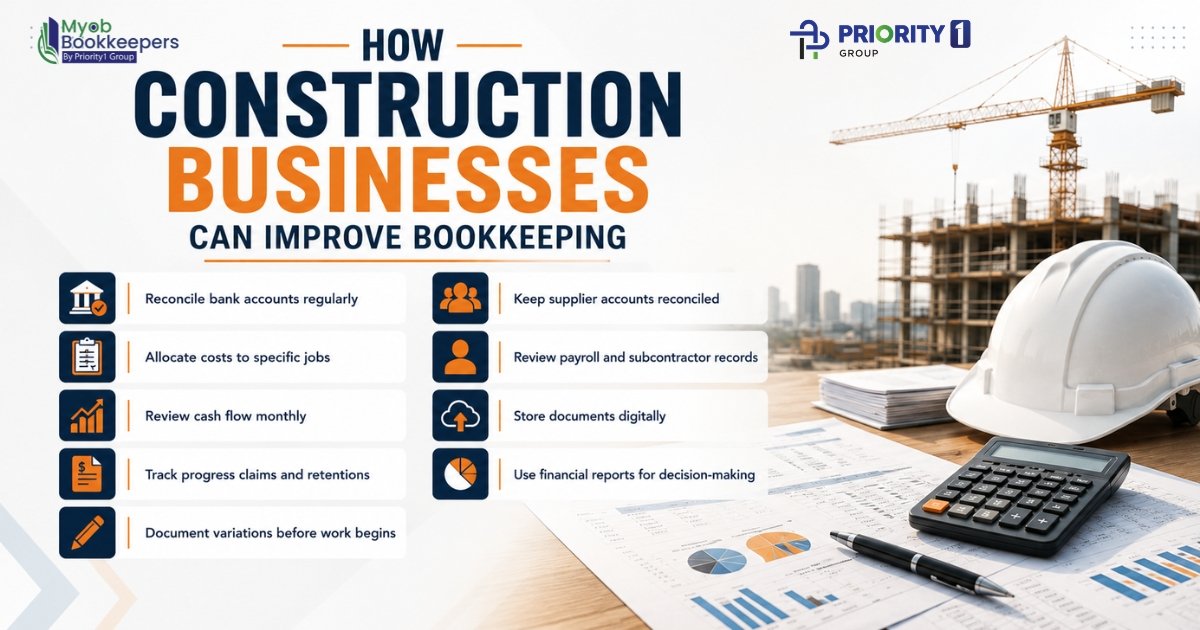
The most effective bookkeeping systems are consistent, practical, and connected to daily operations. Construction businesses should aim to:
Bookkeeping challenges in construction are not minor administrative issues. They directly affect cash flow, project profitability, compliance, supplier relationships, and long-term growth. When financial records are inaccurate or delayed, business owners lose visibility over the numbers that matter most.
Construction companies need bookkeeping systems that reflect the way the industry operates. Job costing, progress claims, retentions, variations, payroll, supplier invoices, and tax obligations all require careful attention.
With accurate records and regular reporting, construction business owners can quote more confidently, manage cash flow more effectively, reduce compliance risk, and understand which projects are truly profitable.
For businesses that want dependable guidance, Priority1 Group can be a helpful resource for building stronger bookkeeping systems and improving financial clarity. The goal is not just cleaner records, but better decisions, stronger margins, and a more resilient construction business.