Running a business involves making decisions every day. Some are small and operational, while others can influence long-term growth, profitability, staffing, and customer satisfaction. Whether it is deciding when to hire new employees, invest in equipment, expand services, or reduce unnecessary spending, every business decision depends on one thing: accurate financial information.
This is where bookkeeping becomes far more than a compliance task.
Many business owners initially view bookkeeping as something that only matters during tax season. In reality, well-managed bookkeeping provides a clear picture of how a business is performing at any given moment. It transforms raw financial data into meaningful insights that support better planning, reduce risk, and improve confidence in decision-making.
Businesses that lack organised financial records often make choices based on assumptions instead of facts. That can lead to cash flow problems, overspending, missed opportunities, and poor forecasting. On the other hand, businesses with reliable bookkeeping systems are usually better prepared to respond to challenges, adapt to market conditions, and plan sustainable growth.
In today’s competitive environment, business owners need timely information they can trust. Bookkeeping provides that foundation.
One of the biggest challenges for growing businesses is understanding their actual financial position. Revenue may appear healthy on the surface, but that does not always mean the business is profitable or financially stable.
For example, a business may generate strong monthly sales while still struggling with overdue supplier payments or inconsistent cash flow. Without accurate bookkeeping, these warning signs can remain hidden until they become serious problems.
Financial visibility allows business owners to:
When records are updated regularly and reviewed properly, business owners gain a much clearer understanding of how their operations are performing.
Cash flow is one of the most important indicators of business health. Even profitable businesses can face financial pressure if cash flow is poorly managed.
Bookkeeping helps business owners monitor incoming and outgoing funds in real time. This visibility allows them to anticipate shortfalls before they occur and make informed decisions about expenses, investments, and payment schedules.
A business owner reviewing accurate financial reports may decide to:
Without current bookkeeping records, these decisions are often reactive instead of proactive.
Experienced professionals understand that good cash flow management is not only about increasing revenue. It is also about timing, planning, and maintaining financial control.
Many businesses focus heavily on sales numbers, but sales alone do not determine success. Profitability depends on understanding costs, margins, overheads, and operational efficiency.
Bookkeeping helps break down financial data into useful categories that reveal what is actually driving profit.
For instance, two services may generate similar revenue, but one may involve significantly higher labour or operational costs. Accurate bookkeeping helps identify these differences so businesses can focus on activities that deliver stronger returns.
This level of insight can support decisions such as:
A business that understands its profitability drivers is in a much stronger position to grow strategically rather than simply increasing workload.
Business planning should never rely purely on instinct. While experience and industry knowledge are valuable, financial data provides the evidence needed to make confident decisions.
Bookkeeping supports planning by providing historical trends and measurable financial information. This allows business owners to forecast future performance with greater accuracy.
When planning for growth, accurate bookkeeping can help answer important questions such as:
Reliable bookkeeping records create a stronger foundation for strategic discussions with accountants, lenders, business advisors, and investors.
Businesses seeking finance or investment are also more likely to build trust when their financial records are organised, transparent, and professionally maintained.
One of the most overlooked benefits of bookkeeping is the reduction of financial stress.
Many business owners feel overwhelmed when financial records are incomplete or disorganised. They may avoid reviewing numbers altogether because they are unsure what they will find.
Consistent bookkeeping creates structure and clarity. Instead of scrambling to gather receipts, reconcile accounts, or estimate expenses, business owners can access accurate information whenever needed.
This helps create confidence in decision-making because choices are supported by facts rather than guesswork.
It also reduces pressure during:
When financial systems are maintained properly throughout the year, businesses spend less time fixing errors and more time focusing on growth.
Modern bookkeeping software has significantly improved the way businesses manage financial information.
Cloud-based platforms provide real-time access to financial data, automated bank feeds, invoice tracking, payroll integration, and reporting tools. These systems allow businesses to review performance more efficiently and identify trends faster.
However, software alone does not guarantee accuracy.
Business owners still need knowledgeable professionals who understand how to interpret financial information correctly, maintain clean records, and identify inconsistencies before they become larger issues.
This is why many businesses work with an experienced MYOB specialist who can ensure financial data remains organised, compliant, and meaningful.
Technology works best when paired with human expertise.
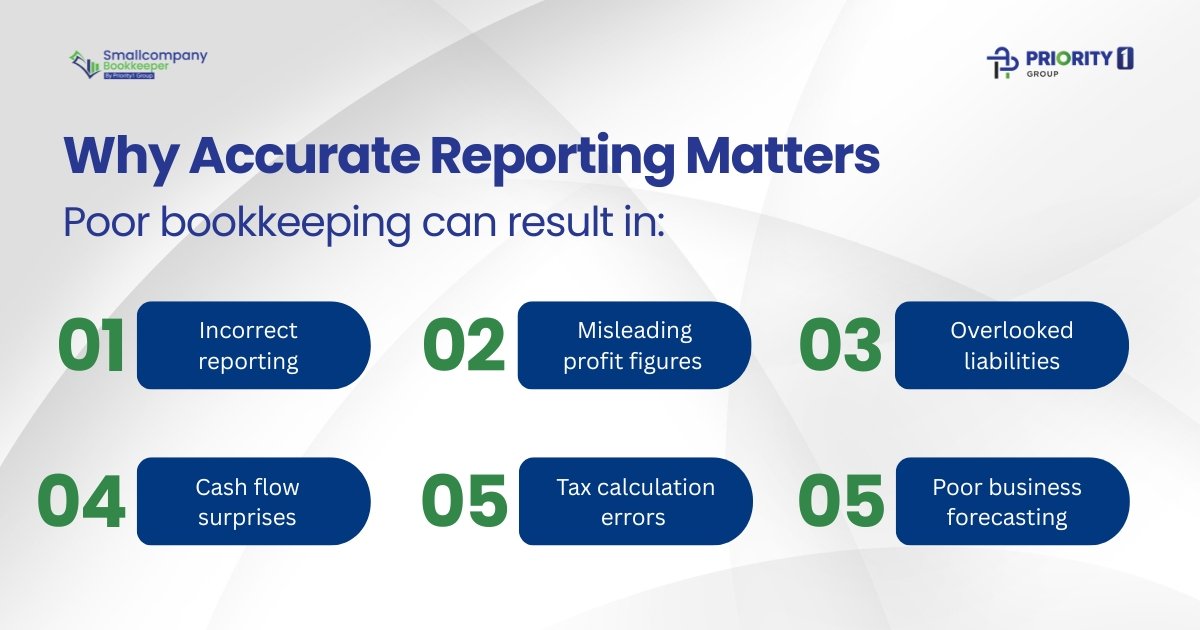
Financial reports are one of the most valuable tools available to business owners.
Reports such as profit and loss statements, balance sheets, and cash flow summaries provide important insights into operational performance. However, these reports are only useful if the underlying bookkeeping is accurate.
Poor bookkeeping can result in:
Accurate reporting helps businesses identify trends early and respond quickly.
For example, if monthly reports show rising operational expenses without matching revenue growth, management can investigate the cause immediately. Similarly, declining profit margins may highlight inefficiencies that require attention.
Decision-making becomes far more effective when reports reflect the true financial position of the business.
Confidence is essential in business leadership.
Business owners are often required to make difficult decisions under pressure. Whether managing staff, responding to market changes, or investing in expansion opportunities, financial confidence plays a major role.
Well-maintained bookkeeping gives leaders confidence because they understand:
This confidence also improves communication with stakeholders, employees, lenders, and advisors.
When leaders understand their numbers clearly, they are generally more decisive, strategic, and prepared.
As businesses grow, bookkeeping responsibilities often become more complex.
Managing payroll, reconciling accounts, tracking expenses, maintaining compliance, and generating reports can consume significant time and attention. Many business owners eventually realise that trying to manage bookkeeping internally without proper systems can lead to costly mistakes.
Working with experienced bookkeeping professionals allows businesses to focus on operations while maintaining financial accuracy behind the scenes.
MyobBookkeepers, which is part of Priority1 Group, supports businesses by helping them maintain organised records, reliable reporting, and efficient bookkeeping systems that improve day-to-day financial decision-making. This type of support becomes particularly valuable for businesses managing growth, multiple revenue streams, or increasing operational complexity.
A qualified certified MYOB bookkeeper can also help businesses better understand reporting tools, compliance obligations, and software efficiencies that save time while improving accuracy.
Some business owners still view bookkeeping as an administrative requirement rather than a strategic business function.
In reality, bookkeeping directly influences the quality of business decisions.
Strong bookkeeping systems help businesses:
Businesses that prioritise accurate bookkeeping are often more resilient during economic uncertainty because they understand their numbers clearly and can adapt more quickly.
This is especially important in industries where margins are tight, cash flow fluctuates, or operational costs change frequently.
Reliable bookkeeping support can help businesses maintain accurate records that contribute to smarter operational and financial decisions over time.
Bookkeeping is far more than a record-keeping task. It is one of the most important tools a business can use to make informed, confident, and strategic decisions.
From managing cash flow and understanding profitability to planning growth and reducing financial stress, accurate bookkeeping provides the clarity businesses need to operate effectively.
The businesses that succeed long term are usually the ones that understand their financial position clearly and make decisions based on reliable information rather than assumptions.
Working with experienced professionals and maintaining consistent bookkeeping systems can help create stronger financial foundations, better operational visibility, and improved decision-making at every stage of growth.
For businesses looking to improve financial clarity and build more confidence in their decision-making processes, Priority1 Group can be a valuable resource. Their experience supporting businesses with structured bookkeeping systems and financial management processes helps organisations stay informed, organised, and prepared for sustainable growth.
A knowledgeable certified MYOB bookkeeper can also play an important role in helping businesses maintain accurate records while making better use of financial data for long-term planning and operational success.