Tax time has a way of arriving faster than expected. One week you are focused on running your business, and the next your accountant is asking for profit and loss statements, GST summaries, and payroll records all at once.
For many Australian small business owners, pulling these reports together is stressful, time-consuming, and often results in back-and-forth emails that delay lodgements and cost extra in accounting fees. Working with a reliable MYOB bookkeeper throughout the year is one of the most effective ways to make sure this process is smooth, accurate, and stress-free when it matters most.
The good news? With the right habits in place, preparing your MYOB reports for your accountant does not have to feel overwhelming. Here is what you need to know.
Before looking at how to prepare your reports, it helps to understand why so many business owners struggle at this stage.
The most common issues include:
If your bank feeds have not been matched and reconciled regularly, your reports will contain errors that your accountant will need to chase down. This adds time and cost to the process.
Applying the wrong tax code to transactions is one of the most frequent bookkeeping mistakes in MYOB. When GST is miscoded, your BAS figures will be inaccurate and your accountant will need to manually review and correct entries before they can work with your data.
With Single Touch Payroll (STP) now mandatory for all Australian employers, your payroll data is reported directly to the ATO each pay cycle. However, if your MYOB payroll records do not match what has been submitted through STP, discrepancies will surface at year end and create additional work.
Transactions that have been entered twice, or not entered at all, distort your financial position and make your reports unreliable.
Getting on top of these issues before you hand anything to your accountant will save both parties a significant amount of time.
Rather than scrambling to fix months of data at the end of the financial year, the most practical approach is to maintain clean, accurate books throughout the year. This is exactly where a dedicated MYOB bookkeeper adds real, measurable value.
A bookkeeper who works with MYOB regularly will ensure your bank accounts are reconciled on a weekly or monthly basis, your GST codes are applied correctly to every transaction, your payroll is processed in line with STP obligations, and your chart of accounts is structured in a way that produces meaningful, usable reports.
When these habits are maintained consistently, generating reports for your accountant becomes a straightforward task rather than a stressful exercise. Your profit and loss statement, balance sheet, GST summary, and payroll reports can be produced quickly and with confidence because the underlying data is already accurate.
This also means your accountant can focus on higher-value work like tax planning, structuring advice, and financial strategy rather than spending billable hours cleaning up data entry errors.
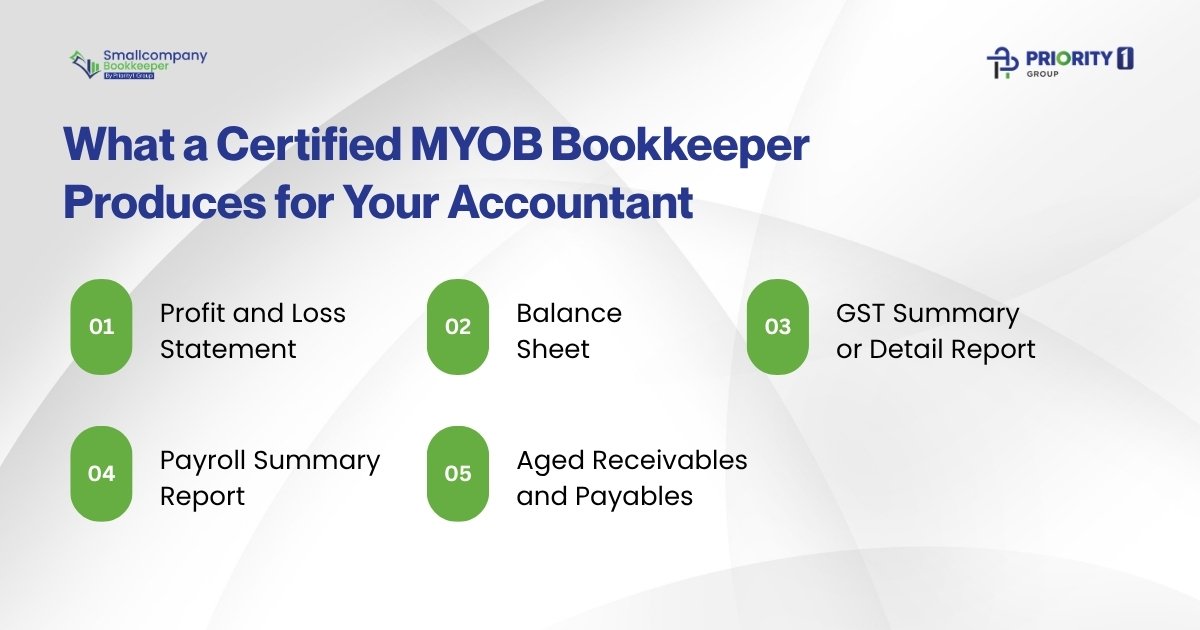
When it comes time to hand reports over, knowing what your accountant actually needs is half the battle. A certified MYOB bookkeeper understands which reports to run, how to configure them, and how to present the data in a format that accountants can work with efficiently.
The core reports your accountant will typically require include:
This shows your income and expenses over a given period. Your accountant uses this to assess your taxable income and identify deductions. Ensure the date range aligns with the financial year or the period being reviewed.
A snapshot of your assets, liabilities, and equity at a point in time. Accountants use this to check the overall financial health of the business and confirm loan balances, owner drawings, and retained earnings are accurate.
This confirms the GST collected and paid over the period and should align with the BAS lodgements submitted throughout the year. Any discrepancies here will need to be explained.
Breaks down wages, superannuation, PAYG withholding, and leave entitlements by employee. This is essential for end-of-financial-year processing and STP finalisation.
Shows what customers owe you and what you owe suppliers. Accountants often review these to ensure outstanding balances are correctly classified.
A certified MYOB bookkeeper knows how to generate each of these accurately and can also provide notes or a reconciliation summary alongside the reports to make the handover process even smoother.
If you are realising that your books are not in the shape you would like them to be ahead of your next accountant meeting, it is worth considering whether you have the right support in place.
When evaluating a bookkeeping service, look for someone who works with MYOB regularly and understands its reporting functions in depth. Ask whether they handle bank reconciliations, payroll processing, and BAS preparation or whether their service is limited to data entry only.
Qualifications also matter. A certified MYOB bookkeeper has completed formal training through MYOB’s certification program, which means they understand the software at a deeper level and are better placed to identify errors, configure reports correctly, and keep your file compliant with ATO requirements.
Also consider how they communicate. A good bookkeeper will not just send reports, they will flag anything unusual, explain what the numbers mean, and give you confidence that what you are handing to your accountant is accurate and complete.
Preparing MYOB reports for your accountant does not need to be a source of stress. With consistent reconciliations, accurate GST coding, and compliant payroll records maintained throughout the year, the end-of-financial-year process becomes straightforward rather than chaotic.
The key is having the right bookkeeping support in place before the pressure of deadlines sets in. As part of Priority1 Group, MYOB Bookkeepers brings together a broader network of business expertise to help Australian small businesses stay organised, compliant, and financially clear all year round.
If you would like to get your MYOB file in shape before your next accountant meeting, reach out to the team at MYOB Bookkeepers for a free consultation. We will review your current setup and make sure your reports are accurate, complete, and ready to go.