
For many Australian business owners, bookkeeping starts as a “do it yourself” task, until growth, compliance, and time pressure make it harder to keep up. MYOB is powerful, but it still relies on clean inputs, consistent processes, and the right knowledge to turn transactions into accurate reporting .
That’s why outsourcing has become the practical choice for businesses that want reliable numbers, fewer surprises at BAS time, and more time back each week. Below is a clear look at what drives the shift, what to outsource, and how to make the arrangement work well, without losing visibility or control.
Outsourcing bookkeeping doesn’t mean you stop caring about your finances. It means you’re building a better system, one where data entry, reconciliations, payroll processes, and reporting happen on schedule, with checks in place, and with less reliance on “catching up later”.
Most businesses outsource when they notice one (or more) of these patterns:
Outsourcing is simply choosing to protect your time and reduce financial risk.
MYOB can produce strong reports, but only when the underlying file is maintained properly. Small inconsistencies create big problems over time: duplicated suppliers, incorrect tax codes, unreconciled clearing accounts, misallocated payroll items, or transactions sitting in suspense accounts.
This is where specialised capability matters. Many businesses prefer working with MYOB experts Australia because they understand not only the software, but also the practical requirements of maintaining a clean file for Australian reporting routines (such as GST mapping, BAS-ready data, and audit-friendly transaction trails).
Outsourcing helps bring discipline to the day-to-day work:
Business owners often underestimate the “hidden cost” of doing bookkeeping themselves: context switching, chasing receipts, fixing errors, and relearning tasks they only do monthly or quarterly.
Even if you can technically do it, it may not be the best use of your highest-value hours.
As transaction volume increases, small errors compound, especially with GST, payroll, and multi-account allocations. Outsourcing introduces routine review and controls, so issues are caught early rather than after months of messy history.
When books are up to date, you can make clearer calls on:
Outsourcing makes reporting reliable enough to actually use.
BAS, payroll obligations, super payments, record-keeping expectations, these don’t get simpler as you scale. Outsourcing helps keep the bookkeeping side consistent, so compliance is a process, not a panic.
Outsourcing isn’t all-or-nothing. Many businesses start by handing over the tasks that are most time-consuming or most risky.
Common outsourced areas include:
A strong outsourcing partner will also document assumptions, keep an audit trail of adjustments, and agree on deadlines so nothing slips.
“Catch up later” usually means:
Outsourcing flips that model. Instead of “best effort bookkeeping”, you get a cadence, tasks, timelines, and accountability. That structure is often the difference between books that look fine and books that actually are fine.
Many growing businesses also prefer a dedicated MYOB bookkeeper so there’s clear ownership of the file, consistent handling of the chart of accounts, and someone who notices problems before they become expensive.
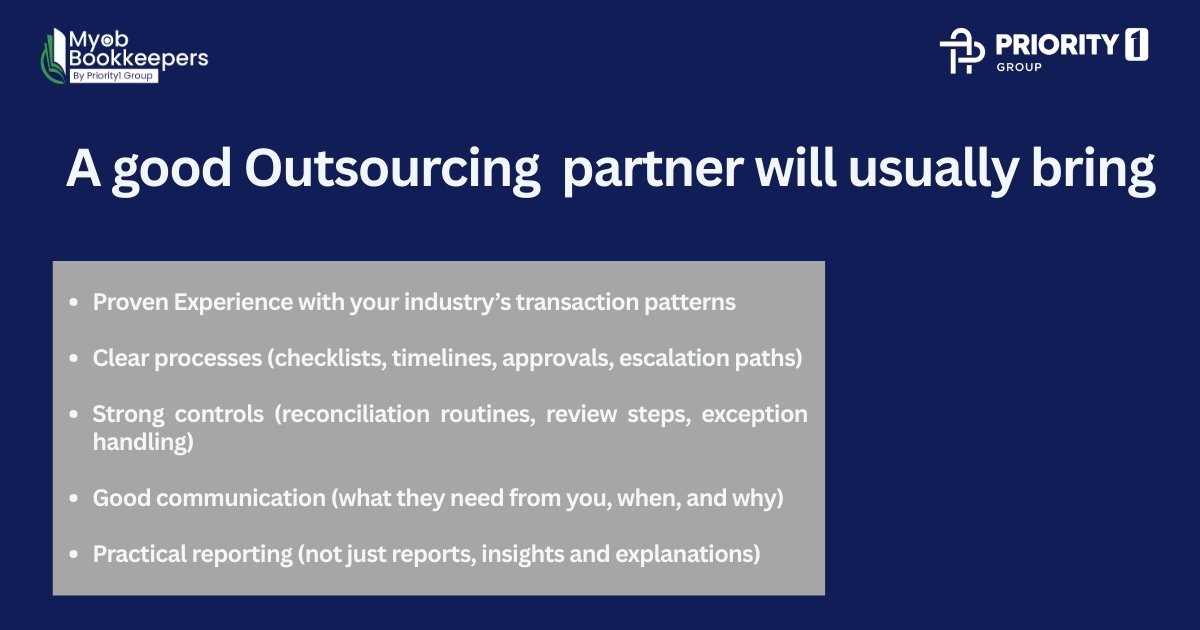
Outsourcing works best when the provider isn’t just “doing data entry,” but actively protecting quality. A good partner will usually bring:
A common fear is: “If I outsource, will I still know what’s happening?” You absolutely can—when the setup includes clear workflows, boundaries, and regular check-ins. In fact, once you understand how outsourced bookkeeping typically works (and what outsourced bookkeeping charges usually cover), it becomes easier to design a system that keeps you firmly in the driver’s seat without doing the day-to-day work yourself.
Here’s a simple control framework that protects visibility and decision-making:
Outsourcing should reduce your workload while increasing your clarity so you’re not “hands-on” in the books, but you’re always across your numbers.
If your goal is smoother processes, cleaner reporting, and fewer last-minute scrambles, it may be time to step away from DIY bookkeeping. Many Australian businesses find outsourcing delivers the best of both worlds: expert handling of the detail, plus better visibility of the big picture.
That’s also where specialist teams can help, especially when they understand both MYOB file health and the realities of running a business. For example, MyobBookkeepers is part of Priority1 Group, and the advantage of a broader group approach is that systems, documentation, and service standards tend to be more consistent across clients, so the work doesn’t depend on guesswork or last-minute fixes.
And as your business grows, the value isn’t only in “getting the books done”, it’s in having numbers you can act on.
Australian businesses outsource MYOB bookkeeping because it creates stability: stable records, stable reporting cycles, and stable compliance routines. It frees up time, reduces costly mistakes, and makes financial reporting usable, so owners can focus on customers, operations, and growth.
If your bookkeeping is currently reactive, outsourcing can be the move that turns it into a dependable system. And if you prefer a partner that can support growth without making it feel salesy or complicated, a structured provider like MyobBookkeepers (within the Priority1 Group family) can be a practical option, especially when you want the work handled consistently and your reports explained in plain English.
When done well, outsourcing doesn’t distance you from your finances, it brings you closer to the truth of them, with less stress attached.