
Running a retail or ecommerce business in Australia means juggling inventory, suppliers, multiple sales channels, and a steady stream of transactions that never seems to slow down. Behind every sale sits a layer of numbers that, if left unmanaged, can quietly erode your margins and land you in trouble with the Australian Taxation Office. Bookkeeping is rarely the reason anyone starts a shop or launches an online store, yet it is one of the few disciplines that consistently separates businesses that scale from those that stall.
This guide draws on the realities Australian retailers and online sellers face every day. Whether you operate a single brick-and-mortar store, a Shopify storefront, or a hybrid of both, the principles here will help you build a bookkeeping system that holds up under pressure and gives you the clarity to make confident decisions.
Most generic bookkeeping advice assumes a service business with predictable invoices and few moving parts. Retail and ecommerce break that mould. You are dealing with high transaction volumes, inventory that ties up cash, fluctuating cost of goods sold, and revenue arriving through several platforms at once: your point-of-sale system, your website, marketplaces like eBay or Amazon, and payment processors such as Stripe, PayPal, and Afterpay.
Each of these channels reports data slightly differently. A single online order might generate a sale, a shipping charge, a discount, a payment processing fee, and a GST component, all bundled into one payout that lands in your bank account days later. If you simply record the net deposit, your books will misstate your actual revenue and expenses. Over a year, those small distortions compound into figures you cannot trust.
This is why accurate, channel-by-channel reconciliation matters so much. Getting the detail right at the transaction level is what makes everything downstream, from tax compliance to profitability analysis, possible.
For Australian businesses, the Goods and Services Tax sits at the centre of compliance. If your annual turnover is $75,000 or more, GST registration is mandatory, and you will need to lodge a Business Activity Statement either monthly, quarterly, or annually depending on your circumstances.
Retail and ecommerce introduce particular GST wrinkles. Selling overseas? Exports are generally GST-free, but you must document them correctly. Importing stock? You will likely encounter GST on imports and may be able to claim it back. Selling low-value goods to Australian consumers from offshore? Different rules again apply. Mixing GST-free and taxable items, such as certain food products alongside general merchandise, demands careful coding so each sale is treated correctly.
The best practice here is straightforward: code transactions accurately as they occur rather than scrambling at quarter’s end. A well-maintained ledger turns BAS preparation from a stressful ordeal into a routine task, and it dramatically reduces the risk of an ATO query.
Inventory is where many retail businesses lose visibility. Your stock represents cash sitting on shelves or in a warehouse, and how you account for it directly shapes your reported profit. Understated inventory inflates your cost of goods sold and hides profit; overstated inventory does the reverse and can lead you to overpay tax.
A disciplined approach means tracking stock levels in real time, reconciling physical counts against your records regularly, and accounting for shrinkage, returns, and damaged goods honestly. Many Australian retailers now use perpetual inventory systems that update with every sale, giving them a live picture of stock value and helping prevent both costly overstocking and lost sales from running out.
Tying your inventory system to your accounting platform removes the manual reconciliation that eats hours each week and introduces errors. When stock movements flow automatically into your books, your cost of goods sold and gross margin stay accurate without constant intervention.
Technology has transformed bookkeeping for small businesses, and the right platform can save a retailer dozens of hours each month. Cloud accounting systems now integrate directly with point-of-sale hardware, ecommerce platforms, and payment gateways, pulling transactions in automatically and matching them against bank feeds.
For many Australian businesses, robust myob bookkeeping software has become a foundation for managing GST, payroll, inventory, and reporting in one connected system. The advantage of a well-chosen platform is not just automation; it is the confidence that comes from having a single source of truth. When your sales channels, bank accounts, and inventory all feed into the same ledger, you spend less time chasing discrepancies and more time understanding what the numbers are telling you.
That said, software is only as good as the way it is set up and maintained. A poorly configured chart of accounts, mismatched integrations, or sloppy categorisation will undermine even the best platform. This is where expertise earns its keep, and where many growing businesses decide that handling everything in-house is no longer the smartest use of their time.
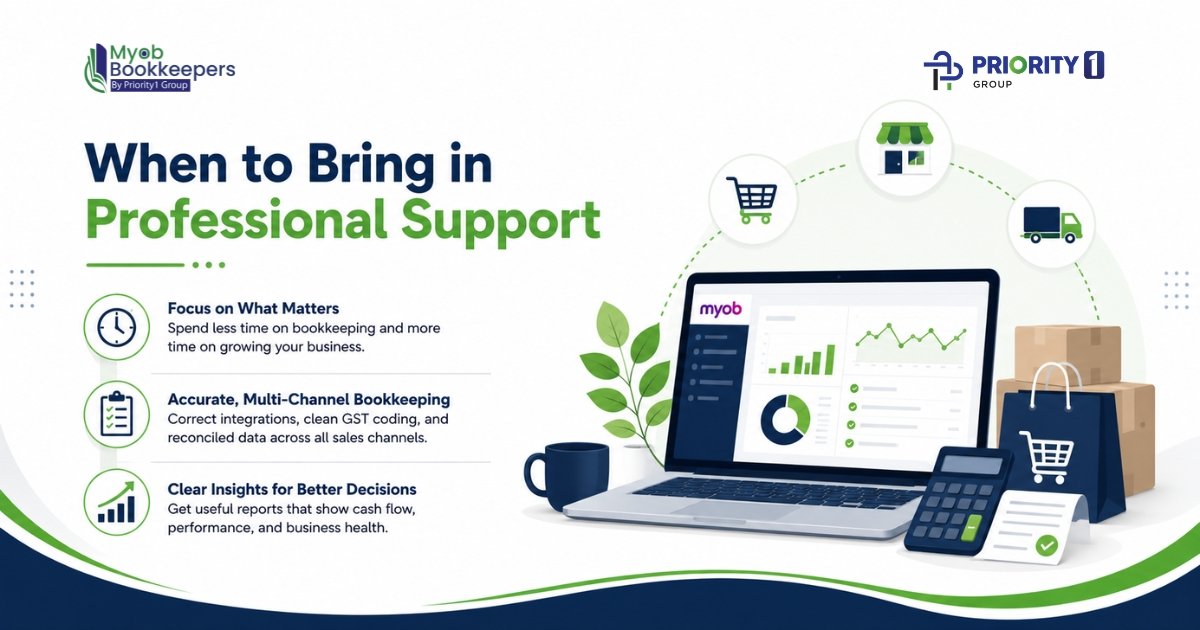
There is a moment in most retail and ecommerce journeys when the founder realises that the hours spent reconciling accounts at midnight would be better invested in buying, marketing, or serving customers. Recognising that point early is a sign of good judgement, not weakness.
MyobBookkeepers, which is part of Priority1 Group, works with retailers and online sellers across Australia to take the complexity of multi-channel bookkeeping off their plates. Because they specialise in the systems many Australian businesses already rely on, they can set up integrations correctly, reconcile across sales channels, keep GST coding clean, and produce the kind of reporting that actually informs decisions. For a business owner who would rather focus on growth than spend evenings untangling payment-processor payouts, that kind of specialist support can be the difference between guesswork and genuine clarity.
Engaging a professional also brings a layer of accountability. A skilled bookkeeper does not just record what happened; they flag anomalies, watch cash flow, and keep you ahead of compliance deadlines rather than reacting to them. Professional myob bookkeeping services can also smooth the path at tax time, giving your accountant clean, reconciled figures to work from instead of a shoebox of half-sorted transactions.
Profit on paper means little if you cannot pay your suppliers this month. Retail and ecommerce businesses are especially vulnerable to cash flow squeezes because money is constantly tied up in stock, and payment processors often hold funds for several days before releasing them.
Good bookkeeping gives you a forward view. By keeping your records current, you can forecast when payments are due, when stock needs reordering, and when seasonal peaks and troughs will hit. Australian retail is highly seasonal, with much of the year’s revenue concentrated around end-of-year sales periods, so understanding your cash position month by month is essential. A reliable set of books lets you plan purchasing and staffing around those rhythms rather than being caught short.
The businesses that handle bookkeeping well tend to share a few habits. They reconcile frequently rather than letting transactions pile up. They keep business and personal finances strictly separate. They retain digital copies of receipts and invoices, which the ATO accepts and which save enormous time during any review. And they look at their financial reports regularly, treating the profit and loss statement and balance sheet as management tools, not just compliance documents.
These habits cost little to establish but pay dividends as you grow. A business with clean, current books can secure finance more easily, attract buyers or investors with confidence, and adapt quickly when conditions change.
Bookkeeping for retail and ecommerce in Australia is not glamorous, but it is foundational. Get the fundamentals right, accurate transaction coding, disciplined inventory management, clean GST handling, and forward-looking cash flow control, and you give your business the stability to grow on solid ground. Get them wrong, and even strong sales can mask a fragile operation.
The encouraging news is that you do not have to master all of this alone. The right combination of well-configured software and experienced human support turns bookkeeping from a burden into a genuine advantage. For Australian retailers and online sellers looking for a trusted partner to bring order to their numbers, Priority1 Group offers the specialist knowledge and hands-on support to make that happen, freeing you to do what you do best: run and grow your business.